

act101
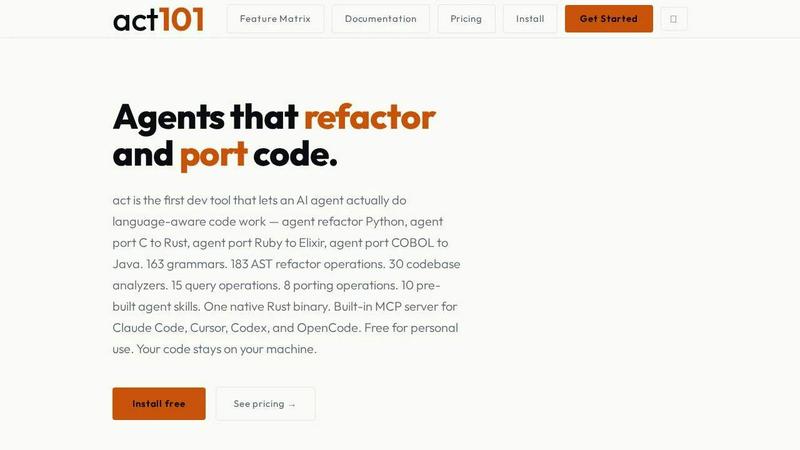
act101 is a single native Rust binary that gives AI coding agents 163 grammar-aware tools for refactoring and porting code across languages.
About act101
act101 is a groundbreaking developer tool that enables AI coding agents to perform language-aware code refactoring and porting across 163 programming languages. Unlike traditional AI coding assistants that rely on whole-file rewrites, act101 exposes a comprehensive suite of 183 Abstract Syntax Tree (AST) refactor operations, 30 codebase analyzers, 15 query operations, 8 porting operations, and 10 pre-built agent skills through a Model Context Protocol (MCP) server. This tool is designed for developers using AI coding agents like Claude Code, Cursor, Codex, and OpenCode who need precise, structural code transformations that preserve formatting, comments, and cross-file consistency. The core value proposition is that act101 lets AI agents actually perform code work rather than just discuss it, with automatic checkpointing and instant undo on every operation. It is built as a single native Rust binary with no plugin runtime, no package graph, and no supply-chain attack surface. Your code stays entirely on your machine with no telemetry, and license verification may contact servers only for verification purposes. The tool is free for personal use, making advanced AI-driven code manipulation accessible to individual developers.
Features of act101
183 AST Refactor Operations
act101 provides a comprehensive library of 183 AST-aware refactor operations that AI agents can execute with precision. These operations include extract-function, rename, move-symbol, convert-to-dataclass, extract-trait, inline, add-type-hints, generate-init, organize-imports, and 174 more across 163 grammars. Each operation works at the abstract syntax tree level, ensuring that code transformations maintain structural integrity, preserve comments, and handle cross-file dependencies correctly. The agent can apply these operations across the entire codebase with automatic checkpointing and instant undo, enabling iterative refactoring workflows that would be impossible with traditional whole-file rewrite approaches.
30 Codebase Analyzers
The tool includes 30 built-in codebase analyzers that provide AI agents with deep structural insights before any code transformation begins. These analyzers cover cohesion, coupling, cycles, chokepoints, hotspots, dead code, layers, seams, clusters, surface area, fan balance, migration readiness, type completeness, and more. When an agent invokes these analyzers, it receives a comprehensive structural map of the repository, enabling informed decision-making about which refactoring or porting operations to apply. This analysis capability transforms the agent from a blind code manipulator into a context-aware engineering partner that understands the architectural implications of its actions.
8 Porting Operations for Language Migration
act101 features 8 specialized porting operations that drive end-to-end language migrations through a contract-inventory-ordering-manifest state machine. The port_contract operation anchors the source-to-target migration, port_inventory enumerates every symbol that must move, port_order resolves dependency ordering, and port_manifest tracks progress through init, add, update, remove, and note states. This structured approach enables AI agents to port code between any two of the 163 supported grammars, such as C to Rust, Ruby to Elixir, or COBOL to Java, with systematic tracking and validation at each step of the migration process.
MCP-Native Architecture with Built-in Server
act101 is built as a Model Context Protocol (MCP) server, making it natively compatible with Claude Code, Cursor, Windsurf, and any other MCP-aware client. The tool is a single native Rust binary with no plugin runtime, no package graph, and no supply-chain attack surface. It requires no indexing, no caching, and has no cold start penalty, as it parses code on each call and results are never stale. This architecture ensures that your code stays entirely on your machine with no telemetry, providing both security and performance benefits for developers working with sensitive or proprietary codebases.
Use Cases of act101
Automated Code Refactoring Across Languages
Developers can use act101 to automate complex refactoring tasks across 163 programming languages. An AI agent can extract functions, rename symbols across workspaces, move TypeScript modules and update all imports, convert classes to dataclasses, and perform 183 other AST-aware operations. Each operation includes automatic checkpointing and instant undo, allowing developers to experiment with refactoring strategies without fear of breaking their codebase. This use case is particularly valuable for large codebases where manual refactoring would be time-consuming and error-prone.
Cross-Language Code Porting and Migration
act101 enables systematic porting of code between any two supported languages through its contract-inventory-ordering-manifest state machine. Teams migrating legacy systems from COBOL to Java, porting performance-critical C libraries to Rust, or converting Ruby applications to Elixir can leverage AI agents to handle the structural aspects of migration. The agent tracks every symbol that must move, resolves dependency ordering, and maintains a manifest of progress, making large-scale language migrations more manageable and less risky than manual approaches.
Codebase Analysis and Architecture Auditing
Engineering teams can use act101's 30 codebase analyzers to gain deep structural insights into their repositories. AI agents can analyze coupling between modules, detect circular dependencies, identify dead code, find chokepoints and hotspots, assess migration readiness, and evaluate type completeness. This analysis capability is invaluable for technical debt assessment, architecture reviews, and planning major refactoring initiatives. The agent receives a comprehensive structural map before touching any code, enabling informed decision-making about where to apply transformations.
Pre-Built Agent Skills for Common Workflows
act101 includes 10 pre-built agent skills that compose its operations into common engineering workflows, such as architecture-audit, code-review, refactoring, code-navigation, code-generation, migration-assessment, boundary-analysis, change-impact, health-check, and architectural-refactoring. Developers can invoke these skills using simple commands like /skill-name in Claude Code, Cursor, or other MCP clients. This use case makes advanced code manipulation accessible to developers who may not be familiar with the full range of individual operations, providing turnkey solutions for everyday engineering tasks.
Frequently Asked Questions
What programming languages does act101 support?
act101 supports 163 programming languages through its comprehensive grammar library. This includes all major languages like Python, Rust, TypeScript, Go, Java, C, C++, Ruby, Elixir, COBOL, and many more. The tool can refactor code within any single language and port code between any two supported languages, making it one of the most versatile code manipulation tools available for AI agents.
How does act101 differ from traditional AI code assistants?
Traditional AI code assistants typically use whole-file rewrites that lose comments, break formatting, and lack undo capabilities. act101 operates at the AST level, providing typed, structural operations that preserve code integrity, maintain formatting, and support automatic checkpointing with instant undo. Additionally, act101 runs entirely on your machine with no telemetry, no indexing, and no cold start, ensuring both security and performance.
Is act101 free to use?
act101 is free for personal use, making it accessible to individual developers and hobbyists. For commercial or team usage, there is a paid pricing tier with additional features and support. The tool is distributed as a single native Rust binary with no dependencies, and license verification may contact servers only for verification purposes. Your code stays entirely on your machine.
How do I integrate act101 with my AI coding agent?
act101 is built as a Model Context Protocol (MCP) server, so it integrates natively with any MCP-aware client including Claude Code, Cursor, Windsurf, Codex, and OpenCode. You can install the tool, start the MCP server, and your AI agent will automatically have access to all 183 refactor operations, 30 analyzers, 8 porting operations, and 10 pre-built skills. No additional configuration or plugins are required.
Pricing of act101
act101 is free for personal use. For commercial or team usage, please see the official pricing page on the act101 website for detailed plan information and tier options.
Similar to act101

Product Launch Checklist
A free launch checklist for SaaS, apps, AI tools and more. Every step says why it matters and when you can skip it.

Forms Plugin
The #1 Native Form Builder Plugin for Framer - No Code, No Embeds, No External Platforms.

Chatit Me - Free Random Chat Alternative
Chat with random strangers online for free on ChatIt.me. Enjoy safe, anonymous, and instant 1-on-1 conversations with people worldwide

PDFKing
Free all-in-one online PDF toolkit to convert, compress, merge, split, edit, organize and protect PDF files quickly and securely.


VidhyaGen
VidhyaGen is a set of lightweight online tools built to help you convert files and create useful outputs fast without unnecessary steps, signups, or


Screen Beaver
Create product videos manually or let your AI agent control Screen Beaver through MCP—no mouse or keyboard needed.